Behind the Dough: How We Make Our Neapolitan Pizza Base from Scratch
We’ve been doing this since 2015. Nine years of stretching dough. Nine years of flour dust under our fingernails. Nine years of watching people’s faces light up when they bite into a perfectly charred crust that’s somehow both chewy and tender at the same time.
Our story starts in Tonypandy, South Wales. Not exactly where you’d expect to find a team obsessed with Neapolitan pizza. But that’s exactly what we are, and it all comes down to one thing: the dough.
When we first started The Welsh Italian Pizza Co, we didn’t just copy what they do in Naples. We studied it. We tested it. We got our hands dirty—literally—to understand what makes Neapolitan pizza so special. And what we discovered is that everything begins with how you treat the dough.
This isn’t a quick process. It’s not something you rush. The magic happens in the waiting, in the slow fermentation, in the way the flour transforms over hours and hours. That’s what we’re going to share with you today: exactly how we make our dough from scratch, why we do it this way, and why you won’t find us reaching for a rolling pin.
The Foundation: Understanding Neapolitan Dough Ingredients
When people ask us what’s in our pizza dough recipe, they often expect a long list. Exotic additives. Secret ingredients. Secret from where?
The truth is simpler than that. Real Neapolitan dough has four ingredients. That’s it.
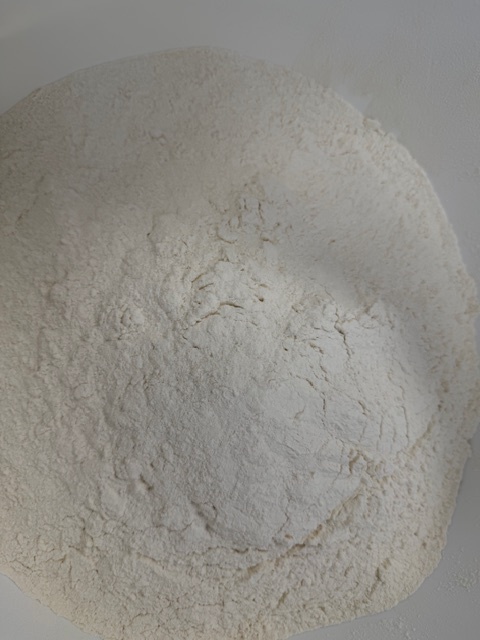
Tipo 00 flour. This isn’t the flour you’ll find in most supermarkets. Tipo 00 is an Italian flour that’s milled to an incredibly fine powder—finer than all-purpose flour, finer than bread flour. When you run it between your fingers, it feels like silk. This matters because the fine texture creates a dough with exceptional elasticity. It stretches without tearing. It puffs without exploding in the oven.
Water. We use about 60% hydration—meaning for every 100 grams of flour, we add 60 grams of water. This creates a dough that’s wetter than you might expect, but that’s precisely why the crust comes out so light and airy. The moisture creates steam in the oven, and that steam is what gives you those beautiful air pockets.
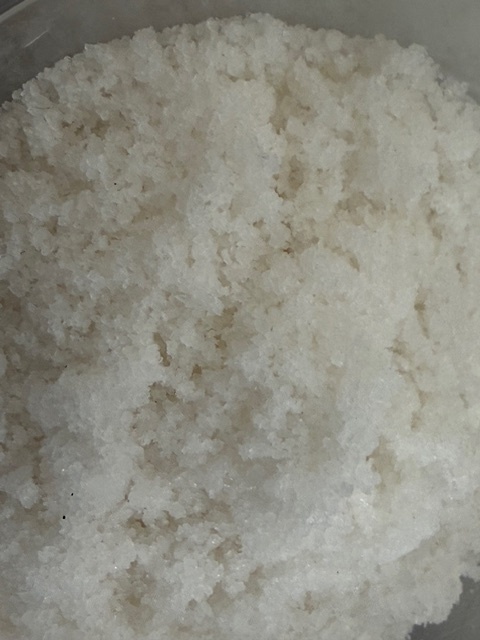
Salt. A small amount—usually around 2.5% of the flour weight. Salt does more than add flavor. It strengthens the gluten network. It controls fermentation. It’s the unsung hero of dough.
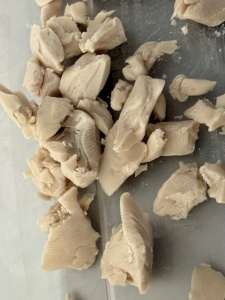
Yeast. We use a tiny amount—often just 0.5% of the flour weight. This seems counterintuitive, but low yeast combined with long fermentation is what creates deep, complex flavor. The yeast has time to work slowly, developing those buttery, earthy notes you taste in authentic Neapolitan pizza.
That’s it. No oil. No sugar. No shortcuts.
We source our tipo 00 flour from Italian mills that have been operating for generations. The difference between quality flour and mediocre flour is the difference between a pizza that’s memorable and one that’s just… pizza. We know this from nine years of testing, adjusting, and tasting.
The Magic Happens Over Time: The Fermentation Process
Here’s where patience becomes your greatest ingredient. If you’re used to pizza chains making a dough in a few hours, what we do is going to seem strange. But stick with us
Our dough ferments for 24 to 48 hours. Sometimes longer.
Let’s walk through what actually happens during that time, because it’s not just waiting. It’s transformation.
Stage One: Mixing and Bulk Fermentation
We combine our four ingredients in the right proportions. The water, yeast and flour go in first. Then the salt. Then the yeast—just a whisper of it. We mix until everything’s incorporated, then we let it rest.
This first rest is crucial. For about eighteen hours at room temperature, the flour is hydrating. The gluten is developing naturally. We’re not forcing it. The dough is getting stronger on its own terms.
Stage Two: Second Fermentation
After those eighteen hours, this is where the real magic happens. We form the dough into balls—usually between 200 and 280 grams each, depending on the size pizza we’re making.
Then they go into an unheated space in our catering setup when we’re on-site. Between 4 – 6 hours.
We’re building strength without overworking it. Then it goes back to rest.
The yeast develops flavour compounds that create depth. We’re talking about real complexity—notes you can actually taste, not just generic yeast flavour.
The dough’s elasticity improves dramatically. Cold fermentation makes the dough more extensible, easier to stretch.
The flavour develops in ways that quick fermentation can’t replicate. We’re creating a dough with character. With soul, even.
This is why there’s no shortcut. You can’t rush fermentation and expect the same result. You can try, and you’ll get pizza, but you won’t get *this* pizza.
We’ve done blind taste tests with our own customers. Pizza made with our 48-hour dough versus pizza made with rushed dough made the same day. The difference is undeniable. The slow-fermented dough has a nutty sweetness. A complexity. The rushed dough tastes like bread.
The Skill: Hand-Stretching Without a Rolling Pin
Once that dough has had its time, it’s ready to become pizza. This is where technique matters.
You won’t find a rolling pin anywhere near our kitchen or our catering setup in Tonypandy. Rolling pins are for flattening things. We’re not flattening. We’re stretching. There’s a huge difference.
Flattening with a rolling pin crushes the air bubbles. It squeezes out the gas that took 24 to 48 hours to develop. That’s why commercial pizza chains use them—they’re fast and efficient. But fast and efficient isn’t what we’re after.
Hand-stretching preserves those bubbles. It respects the work the dough has already done.
The Technique Itself
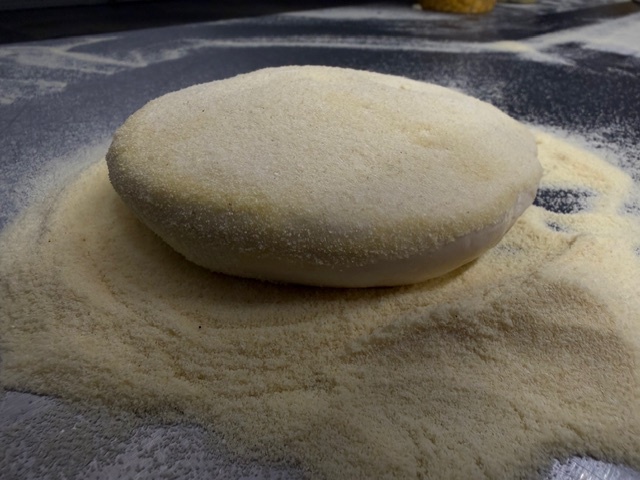
We start with a dough ball that’s been at room temperature for about 4 to 6 hours. This is important. Cold dough coming straight from the fridge is tight. It’s not ready. Room temperature allows it to relax, to become workable.
We dust our hands and our work surface lightly with tipo 00 flour. Too much flour and you’re drowning the dough. Just enough to prevent sticking.
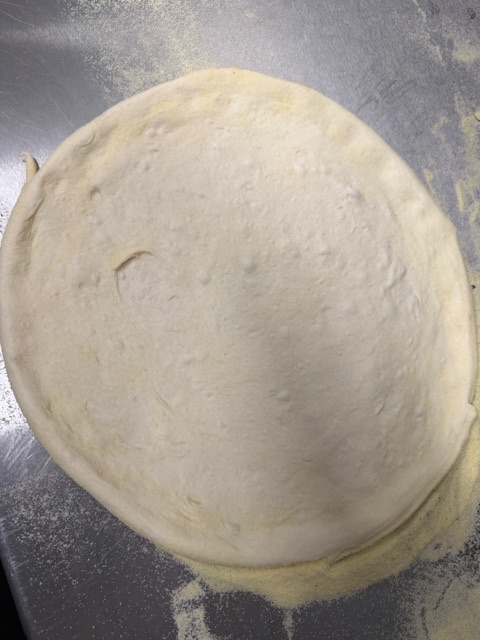
The first step is a gentle press. We place the dough on the counter and press it flat with our fingers, leaving the edges slightly thicker. These edges will become the crust—the cornicione—and they need that extra volume to puff up in the wood-fired oven.
Then comes the stretch. We lift the dough from the centre outward, rotating as we go. Slow rotations. Patient stretches. Some pizzaiolos (pizza makers) use the traditional slap technique—tossing the dough and letting gravity and momentum do some of the work. We use a combination: hand-stretching, occasionally lifting and rotating.
The key is listening to the dough. If it’s resisting, you stop. You let it rest for a minute. Then you try again. Force it and it tears. Respect it and it transforms into something beautiful.
We usually stretch our dough to about 30 centimeters (roughly 12 inches). Thin enough to cook quickly in our wood-fired oven. Thick enough that it’s not fragile. There’s a sweet spot, and after nine years, we’ve learned where it is.
One of our regular customers, Gareth from Merthyr Tydfil, jokes that he can tell which pizzaiolo stretched his pizza based on the thickness variation. He’s not wrong. Each of us has a slightly different touch. That’s not inconsistency—that’s character.
Why This Matters in a Wood-Fired Oven
Wood-fired oven pizza is where everything we’ve done comes together. And it’s why our method works.
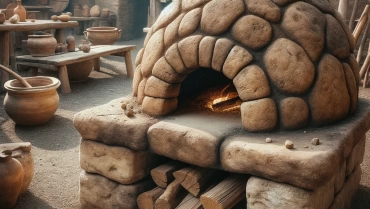
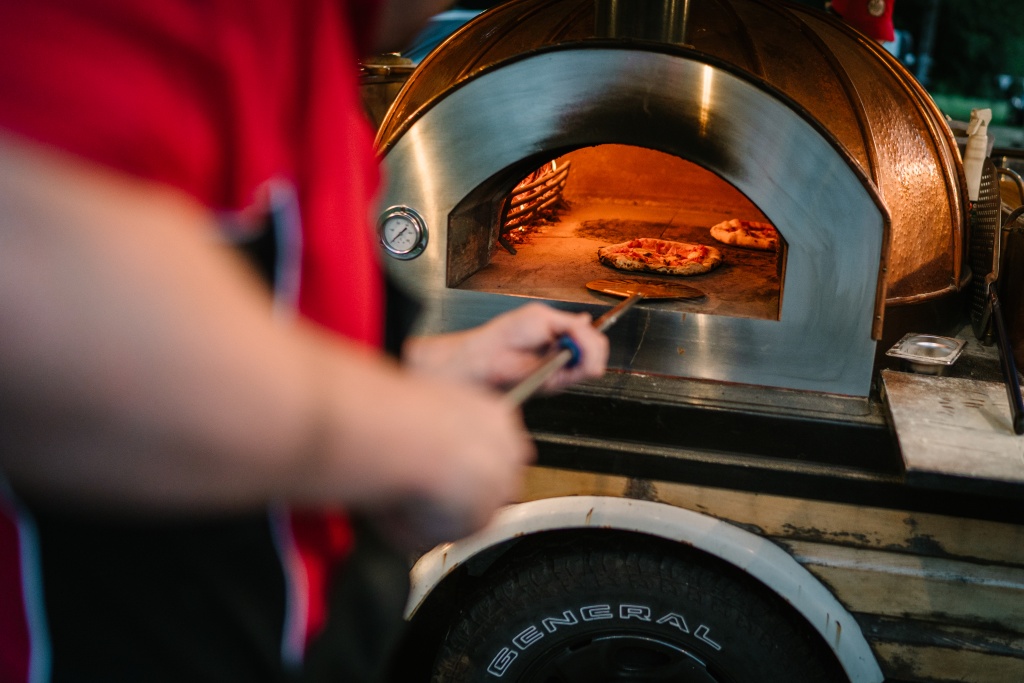
Our ovens reach temperatures around 350°C (about 660°F) to 400°C (750°F). Some authentic Neapolitan pizzerias go higher. At these temperatures, everything happens fast. Really fast.
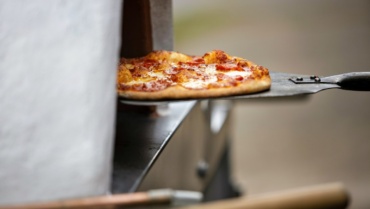
If you’ve ever watched pizza cook in a commercial deck oven at 250°C, you know it takes 12 to 15 minutes. Our wood-fired oven cooks pizza in 60 to 90 seconds. Sometimes less.
This speed is only possible if your dough is ready. If your dough has been fermented properly, if those air bubbles are developed, the crust will puff and cook before it burns. The outside chars—that’s intentional, that’s flavour—but the inside stays tender.
Quick cooking at high heat means you’re not driving all the moisture out. That’s why wood-fired Neapolitan pizza is so moist on the inside, so chewy, so different from pizza that’s been baked slowly. The technique and the equipment are inseparable.
We’ve set up our wood-fired pizza service across South Wales for nearly a decade. Weddings in Neath. Festivals in Caerphilly. Birthday parties in the Valleys. And every single time, the dough is the foundation. The oven is just the stage where it shows what it can do.
How Neapolitan Dough Differs from Commercial Pizza
Let’s be honest: most pizza isn’t Neapolitan. Most pizza is made with methods designed for speed and consistency, not flavour.
Commercial pizza dough is typically mixed with added oil and sugar. The oil extends shelf life and makes the dough easier to handle. The sugar feeds the yeast, allowing faster fermentation. You can have dough ready in a few hours. In some operations, it’s ready in 30 minutes.
The result is consistent, uniform, and adequate. But it’s not good.
Neapolitan dough has no oil (beyond what might be on the outside of the ball), no sugar. It relies on proper technique and time. This makes it harder to manage—it’s more temperamental, more dependent on conditions—but it’s also more alive.
Commercial dough is designed to be forgettable. You eat the pizza and you’re satisfied because it’s food. Neapolitan pizza is designed to be memorable. You finish eating and you’re already thinking about the next slice.
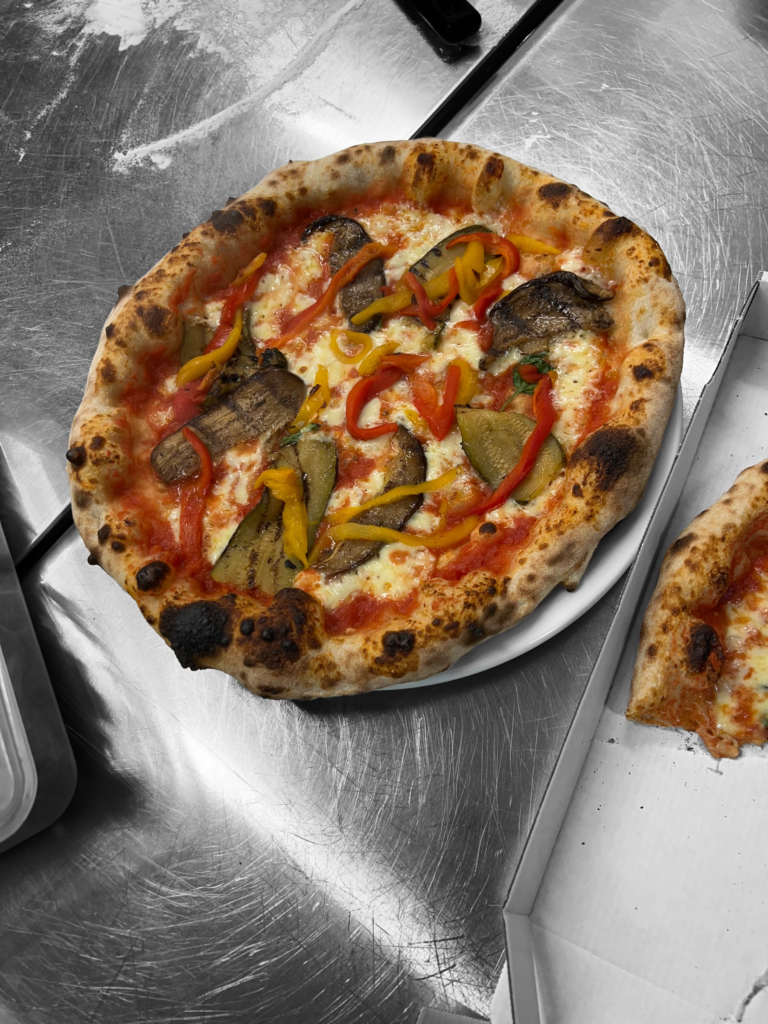
The difference shows up in texture. Commercial pizza, even decent commercial pizza, is denser. The crumb is tighter. It feels heavier in your mouth. Neapolitan pizza is light. It has an open crumb structure. You can see the holes. That’s fermentation doing its job.
The difference also shows up in flavour. Commercial dough tastes like yeast. Neapolitan dough tastes like grain. Like possibility.
We’ve converted plenty of customers who thought they liked pizza. Once they’ve had authentic Italian pizza made with proper Neapolitan technique, they realize they were just eating bread with toppings.
Our Specific Process at The Welsh Italian Pizza Co
We don’t claim to do exactly what they do in Naples. We’re in Wales. We use Welsh water. Some of our ingredients come from Welsh suppliers. We’ve adapted the method to work with our catering setup, our mobile wood-fired ovens, our climate.
But the fundamentals? Those are pure Neapolitan.
Here’s our rhythm:
We make dough in batches, usually late in the day. We’re thinking about what events we have coming up, how many pizzas we’ll need, whether we want more dough ready or less. The mixing happens in our kitchen in Tonypandy. We use a commercial mixer, but we don’t overwork the dough. Once it’s mixed and has initial strength, it’s done.
The bulk fermentation happens overnight, sometimes longer. The dough gets stronger. The flavour develops.
The next morning or afternoon, we divide and shape into balls. Each ball gets attention. We’re not throwing dough around. We’re being deliberate. We oil each one and put them in containers that will travel with us.
The day of an event—a wedding in the Vale of Glamorgan, a festival in Pontypridd, a private party—the dough is removed from cold storage a few hours before service. It reaches room temperature. It relaxes.
When we’re ready to make pizzas, we stretch each ball by hand. We top it. We launch it into the oven. Ninety seconds later, it’s done.
There’s a meditative quality to this process. We’ve done it thousands of times, but it still requires focus. Each ball is slightly different. Each one wants something slightly different. You have to pay attention.
Sarah, who’s been with us since the beginning, says she can feel when a dough is ready just by the way it responds to her hands. That’s not magic. That’s experience. That’s the result of making thousands of pizzas.
The Tools We Actually Use
We get asked this a lot: what equipment do you need?
For the dough itself, honestly, very little. A mixer. A scale (precision matters). Our hands. A container for fermentation.
For stretching, we don’t need much either. A work surface. Tipo 00 flour for dusting. Our hands.
If you’re getting fancier about it, a banneton (proofing basket) can help during fermentation, especially if you’re stacking dough balls. A thermometer is useful for tracking fermentation temperature. But these aren’t essential.
The thing we spend money on is the wood-fired oven itself. That’s where the investment goes. And it’s worth it because it’s impossible to replicate Neapolitan pizza in a conventional oven. The heat profile is different. The cooking time is different. The result is completely different.
We use a proper wood-fired oven built to specifications—thick walls, the right shape, a floor that holds heat. It’s not something you improvise. But once you have it, the dough does the rest.
Why We Don’t Compromise on This
Over nine years, we’ve had opportunities to cut corners. To use commercial dough from a supplier. To add oil and sugar to speed things up. To use faster fermentation times and claim we’re doing something we’re not.
We haven’t done any of that. Not because we’re stubborn (though we might be a bit), but because it would make us ordinary. And we didn’t start The Welsh Italian Pizza Co in Tonypandy to be ordinary.
The dough is your opportunity to make something remarkable. Once you’ve tasted the difference, you can’t un-taste it. Your customers will feel it. They’ll taste it. They’ll notice that their pizza is lighter, more complex, more interesting than pizza they’ve had elsewhere.
That’s worth the work. That’s why we’re still doing this the way we do.
If you’re planning an event and you want authentic Italian pizza—not just pizza that looks Italian, but pizza that’s built on proper technique and time—then you’re already thinking the way we do. Get in touch and let’s talk about bringing our wood-fired oven to your celebration. We’ll stretch your dough by hand. We’ll cook it hot and fast. We’ll make something you’ll remember.
Because at the end of the day, pizza that’s worth eating is pizza that’s worth the effort to make properly.